/Project Details
Association Mining and Eye-Tracking Clustering
A data mining pipeline that combines association rule mining and DBSCAN clustering to analyze scanpath-style eye-tracking behavior.
This project brings together two classic data mining approaches in the context of eye-tracking data. First, scanpath-like page-area sequences are treated as transactions, and association rule mining is used to reveal which website elements tend to be inspected together.
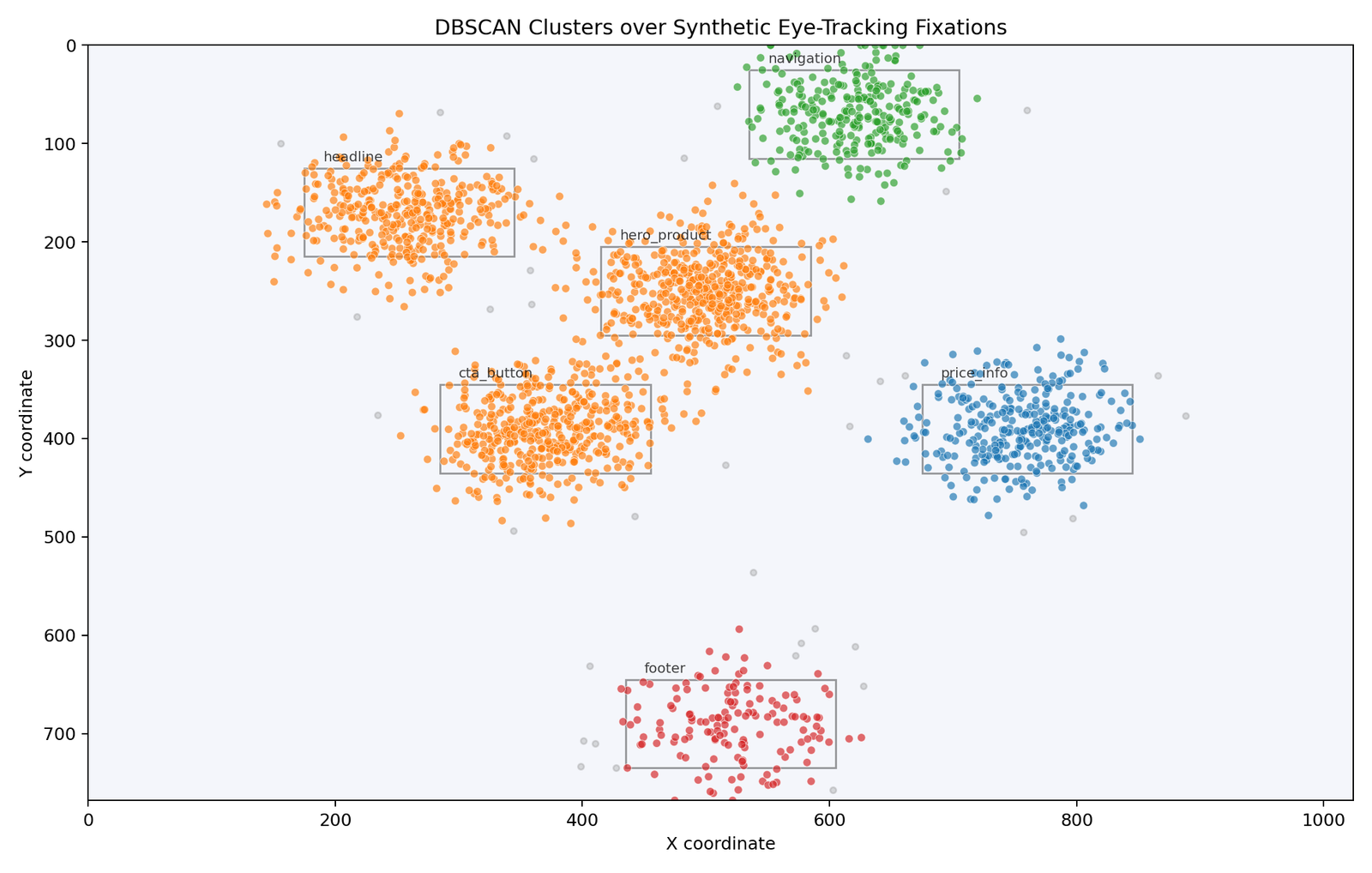
Second, fixation coordinates are clustered with DBSCAN to identify dense visual attention regions on the page. This is especially meaningful for eye-tracking data because such data is both sequential and spatial: users move across page elements over time while also forming gaze clusters on the screen.
The project works with synthetic gaze and scanpath data modeled after a web usability study while preserving the core methodology: frequent itemsets, support, confidence, lift, and density-based clustering.
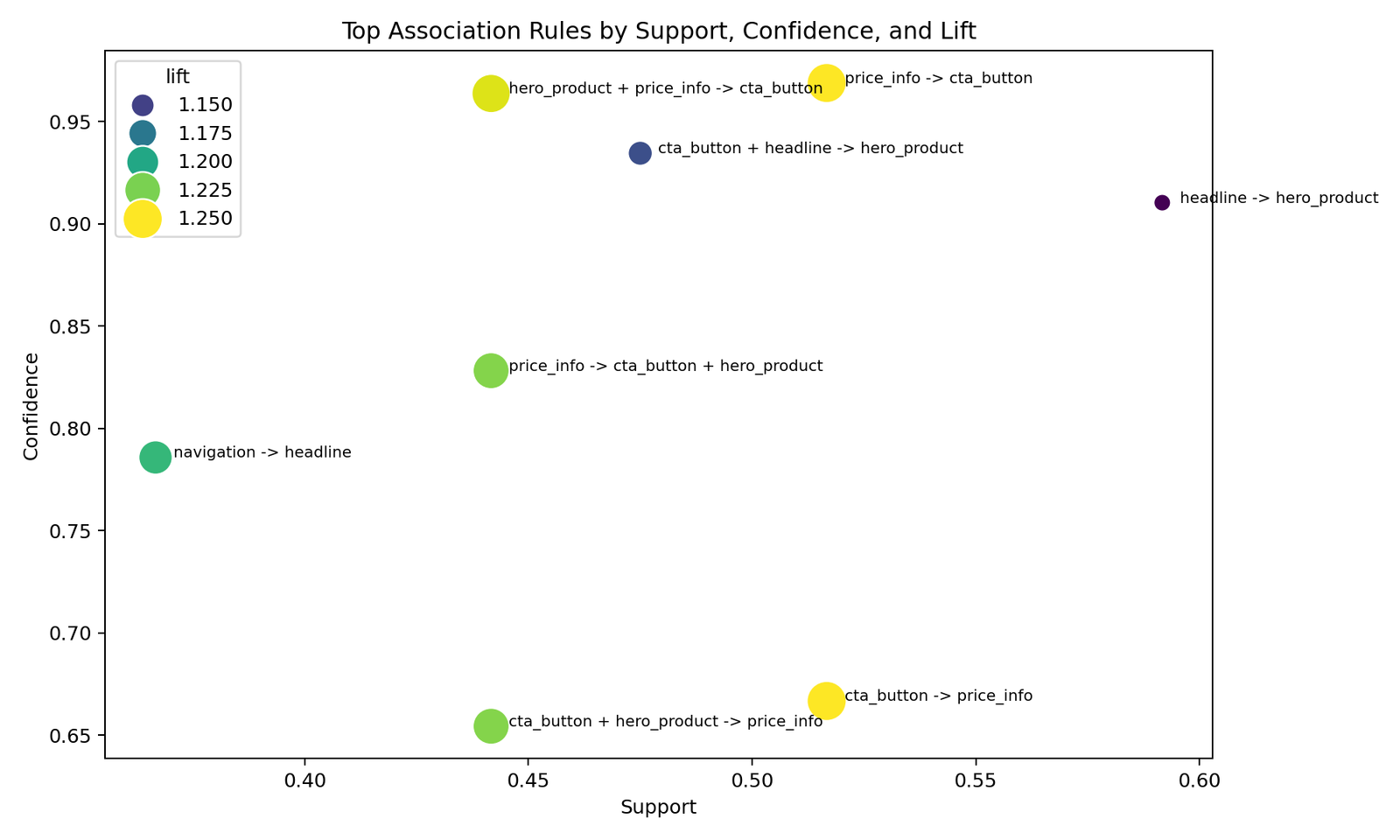
In the resulting examples, rules such as price-information and CTA co-attention appear with high confidence values, while DBSCAN successfully isolates dense fixation regions and leaves outliers as noise.
Highlights
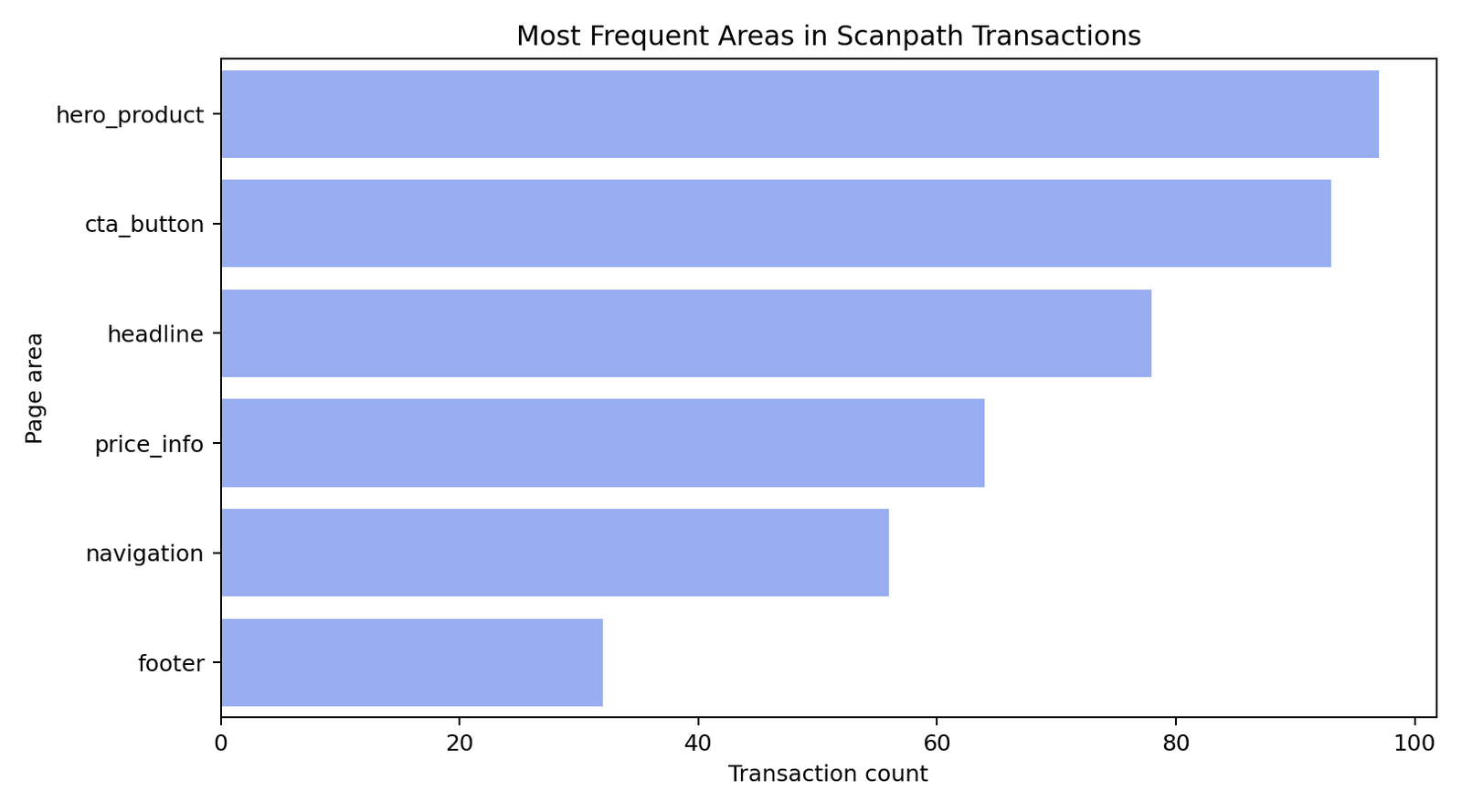
- Generated scanpath-style transaction data from page areas such as hero product, headline, CTA, price information, navigation, and footer.
- Implemented frequent itemset mining and association rule scoring with support, confidence, and lift.
- Generated fixation coordinates around page areas and clustered them with DBSCAN.
- Produced diagnostic figures for page-area frequencies, top association rules, and fixation clusters.
- Preserved the core data-mining methodology while working in a synthetic-data setting.
Figures